
Funeral Wreaths Sydney: A Practical Guide When You Have No Time
Most people order a funeral wreath once or twice in a lifetime, usually within twenty-four hours, usually while dealing with something much harder. This is written to answer the questions quickly so you can make one phone call and be done.
What a Wreath Is, and What It Signifies
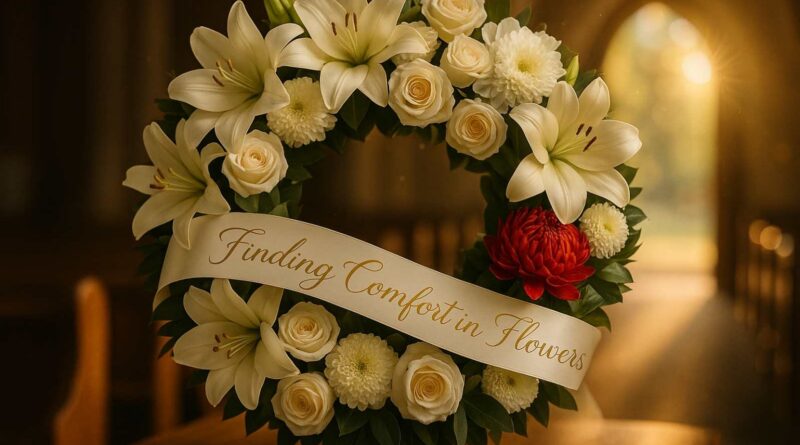
A wreath is a circular tribute, traditionally understood to represent eternity and the circle of life. It is the most formal of the standard Funeral Wreaths Sydney tributes and the one most often sent by extended family, colleagues, clubs and organisations rather than by immediate family.
It is built on a ring base, usually floral foam, so the flowers stay hydrated through the service. It can be presented two ways:
On an easel, standing upright beside or behind the coffin during the service. This is the most visible option and the most common for chapel services.
Laid flat, at the graveside or in front of the coffin. Traditional for burials, and sometimes preferred for smaller or more intimate services.
Say which you want when you order, because it changes how the wreath is finished and whether an easel is provided.
Wreath vs the Other Tributes
Worth knowing what you are choosing between.
- Wreath – circular, formal, on an easel or laid flat. Extended family, colleagues, organisations.
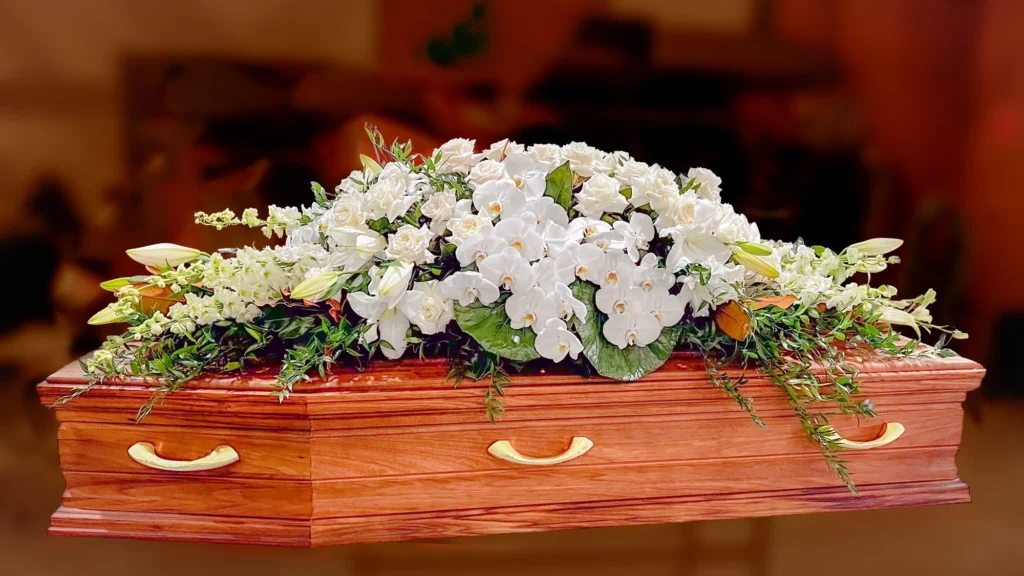
- Casket spray or coffin arrangement – sits on top of the coffin. Almost always ordered by immediate family, and usually only one.
- Sheaf or flat spray – flat-backed, laid on the coffin or beside it. Less formal than a wreath, and generally less expensive.
- Posy or vase arrangement – sent to the home rather than the service. Often the more useful gesture, because it lasts beyond the day.
- Heart, cross or lettered tributes (MUM, DAD, NAN) – traditional in some communities, and specific to immediate family.
If you are not immediate family and you are unsure, a wreath is always appropriate and never oversteps.
Sizes and Costs in Sydney
Wreaths are described by diameter. Rough 2026 guidance, buying direct from a workroom:
- 12 inch (30cm) – $130-190. Modest, suitable for a small service or a graveside placement.
- 15 inch (38cm) – $190-280. The standard size and the most commonly ordered.
- 18 inch (45cm) – $280-420. Generous, reads well on an easel in a larger chapel.
- 24 inch (60cm) – $450-700. A statement tribute, usually from a large family group or an organisation.
Wreaths are labour-intensive relative to a bouquet, because every stem is cut short and individually placed into foam, and the whole surface must be covered. A 15 inch wreath uses considerably more stems than most people expect – typically seven or eight large focal blooms plus twenty-five to thirty secondary flowers, on top of the foliage base.
If several people are contributing, it is usually better to combine into one larger wreath than to send three small ones.
Timing: The Part That Matters Most
This is where funeral flower orders go wrong, and it is entirely avoidable.
Tributes go to the funeral home or chapel, not to the family’s house, unless you have been told otherwise. Funeral directors receive and arrange flowers before the service.
Delivery needs to be at least 90 minutes before the service starts, and most funeral homes prefer two hours. Chapels run back-to-back services and the flowers need to be placed before mourners arrive.
Order the day before if you possibly can. A wreath is a substantial piece of work and cannot be built in twenty minutes. Same-day is often possible but needs an early morning call.
Confirm the exact details with the funeral director or the family: full name of the deceased, funeral home name and address, chapel name if there are several, and service time. Large Sydney funeral homes run multiple chapels and misdirected flowers are common.
If the service has already happened, send a vase arrangement to the home instead. It is more useful anyway.
The Ribbon and Card
Wreaths usually carry a ribbon and a card. Both should be short.
Ribbon wording is typically a relationship or a group name: Beloved Grandmother, With Love from the Family, From all at [company name], Rest in Peace.
Card wording – keep it to one or two lines and sign it clearly:
- With our deepest sympathy. Thinking of you all.
- In loving memory of a remarkable man.
- With love and sympathy from the Watson family.
- Our thoughts are with you. He will be greatly missed.
- With sympathy from everyone at the club.
Avoid anything that requires the family to reply, and avoid religious language unless you know it will be welcome. Sign with your full name – the family may not recognise a first name alone, and they will be reading many cards.
Cultural and Religious Considerations
Sydney is diverse and funeral flower customs vary considerably. When in doubt, ask the funeral director.
- Orthodox and many Catholic services – flowers welcome and expected. White, cream and traditional tributes.
- Jewish funerals – flowers are generally not customary. A donation to charity, or food sent to the family during shiva, is the appropriate gesture.
- Islamic funerals – flowers are usually not part of the tradition, and simplicity is valued. Check before sending.
- Buddhist and many Asian services – white and yellow are appropriate; red is generally avoided.
- Hindu services – flowers, particularly garlands, are traditional. White and yellow are common.
- Chinese funerals – white and yellow chrysanthemum are traditional and appropriate; red is avoided.
“In lieu of flowers, donations to…” appears frequently in death notices. If the family has requested that, respect it, and send a card rather than a tribute.
Palette and Flower Choices
Traditional and always appropriate: white and cream. White chrysanthemum, white rose, white lily, lisianthus, carnation, with dark green foliage.
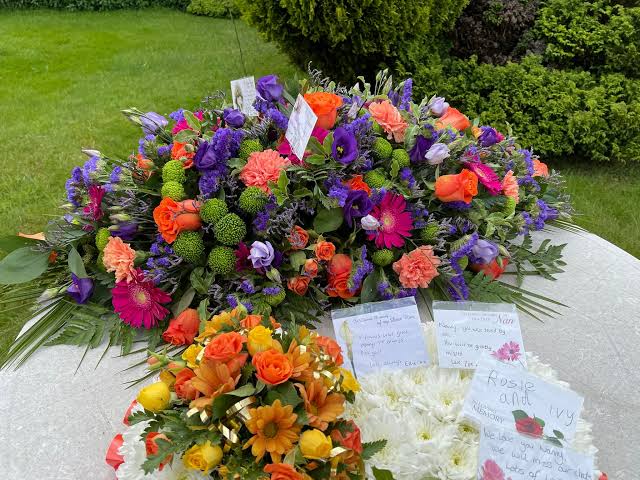
Increasingly common and often more personal: the colours the person actually liked. A wreath in warm coral and gold for someone who hated formality reads as thoughtful, not disrespectful.
Australian natives are a strong choice, particularly for someone with a connection to the bush or the coast. Banksia, protea, waratah, gum foliage and flannel flower make a distinctive and dignified wreath, and they hold up exceptionally well through a long service in a warm chapel.
Worth knowing that native material used commercially is regulated. NSW licenses the harvest and cultivation of protected native plants for the cut flower trade through the cut-flower licensing framework, which distinguishes wild-harvested from cultivated stock. Waratah and flannel flower sit in the most tightly controlled groups. A reputable florist can tell you which they are using.
Remove lily anthers. Lily pollen permanently stains fabric and a chapel is not the place for it. A good florist does this automatically.
Chrysanthemum Deserves Defending
It is the classic funeral flower and it has an unfair reputation in Australia. Modern varieties – the antique bronzes, the deep burgundies, the green-centred whites, the fringed doubles – are genuinely beautiful and nothing like the servo bunch. They are also extraordinarily durable, which matters in a warm chapel and matters again if the family takes the wreath to the graveside afterwards.
Most of it is grown locally. NSW’s cut flower industry is concentrated around the Sydney basin, the Hills District and the Central Coast, described in the state’s horticulture and primary industries resources, which is why chrysanthemum from a Sydney florist arrives in far better condition than an imported equivalent.
If You Are Arranging the Funeral
Flowers are one line item among many, and it is worth knowing how they sit alongside the rest. The NSW Government’s guide to arranging a funeral explains that funeral directors must provide an itemised written quote, that floral tributes are often arranged through them as a disbursement, and that you are entitled to arrange flowers directly with a florist instead. Doing so is usually cheaper and gives you more control over the design.
Ordering Checklist
- Full name of the deceased.
- Funeral home name and address, and the chapel if there are several.
- Service date and time, so delivery can be 90 minutes to two hours prior.
- Wreath size, and whether it is going on an easel or laid flat.
- Ribbon wording.
- Card message, signed with your full name.
- Any cultural or family preferences, including “no flowers” requests.
The Bottom Line
A funeral wreath is the safe, formal and always-appropriate tribute when you are not immediate family. Order a 15 inch as the sensible default, send it to the funeral home rather than the house, get it there at least ninety minutes before the service, confirm the chapel name, and sign the card with your full name. If the family has asked for donations instead, send a card and honour that. One phone call to a real florist with those details sorted takes about four minutes.